Swaziland Railway (SR)

(25./26.10.06)


Railway history in Swaziland has started as recently as 1964, when a cape gauge line was opened from the Mocambique border at Siweni to the iron-ore mine at Ka Dake (to the north-west of Mbabane). Now, after the mines have closed, the line terminates in  Matsapha, which can be regarded as the present-day railway freight hub of Mbabane and Manzini.  The line is now served as a branch line to the newly-built north-south transit line that connects Natal with Komatipoort. While the north-south line is operated as a through route by Spoornet with SR drivers, the branch line to Matsapha is served by Spoornet locos that are on long-term hire to SR [according to JM-94] .  Freight to/from Matsapha apparently consists of timber, containers, and petro-chemical products. The station area is fenced, but a level crossing provides easy access. In the early, overcast afternoon of 25.10.06, Spoornet 34201 has just finished shunting and is ready to leave with a considerable load:


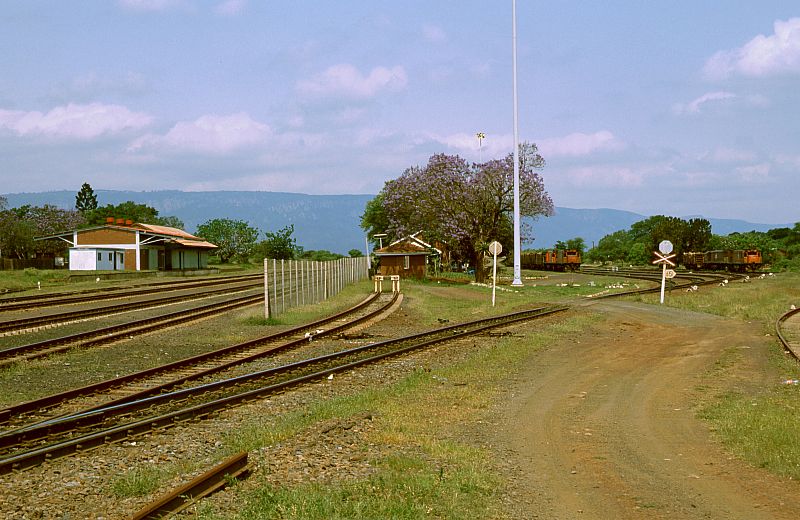
Three sidings complete the layout (picture taken from level crossing):


Just a couple of miles along the line towards the east, the tiny and somewhat unpleasant settlement of Sidvokodvo used to host Swaziland Railway's steam depot. Since John Middleton [JM94] reported 15AR 2098 to be preserved (or maybe just stored) here, we tried to visit the place, but this turned out to be impossible without a written permission from Mbabane headquarters. The whole station area remained hidden in a couple of hundred yards distance behind an extensive network of fences. Given that Swaziland Police happens to be one of the neighbours, we decided not to try and find an opening. A private enterprise (something like XYZ Carriage Ltd - foolishly I did not write the name down - can someone help here?) seems to use the shed area, probably doing repairs to rolling stock.

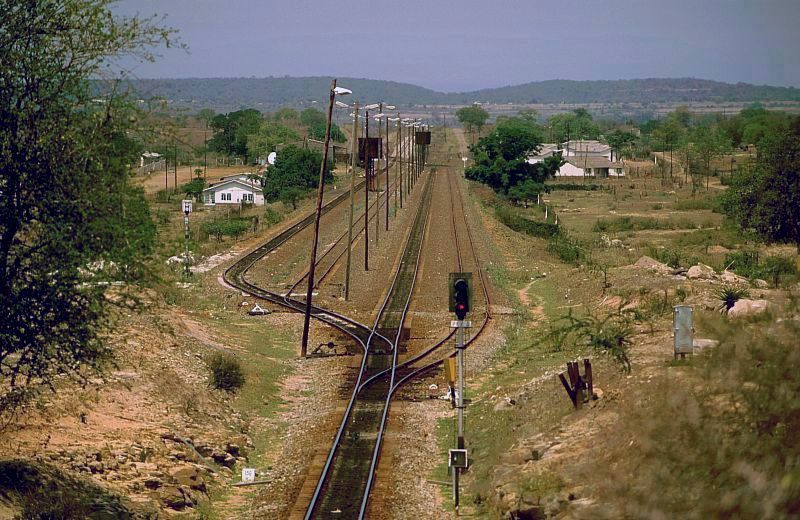
At Phuzumoya, the branch line from Matsapha connects with the north-south main line. Given that this is a very important junction in the SR network, I was surprised to find a very quiet station with a rather modest layout (picture taken from road overpass):


At the far end of the station, the line splits into the branches to Lavumisa (left) and Matsapha (right) - hope my sense of orientation has not failed here:


CTC is operational but remained all red during our (short) visit. A triangle is still in place but obviously out of use. A couple of sidings have long been lifted.


The diesel depot of SR is located in Mpaka, about 30 km north of Phuzumoya. Here the northern part of the original iron ore line to Siweni and Maputo branches from the new north-south main line. Obviously, this is the most important railway station in Swaziland. All trains seem to stop here, most probably to change drivers. Again the station area is fenced. In the late afternoon hours of Oct 25th, nobody seemed to mind me using a very popular (also to the general public) gap in the fence and crossing a number of tracks to get closer to 34232, who was idling in front of a long northbound train:


When we returned to Mpaka next morning (i.e. on Oct 26th) after a very pleasant night at a farm in Siteki, I was told that what I was doing was unlawful even before I got to that gap in the fence. Luckily the MR3 road overpass gave reasonable photo opportunities for 37055, who just left with an empty timber train towards Mananga / Komatipoort. The workshop area can be seen in a distance on the left:


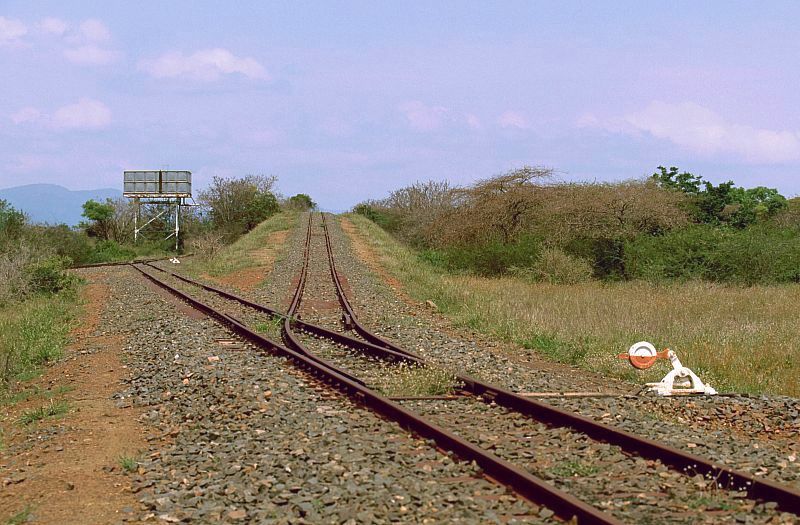
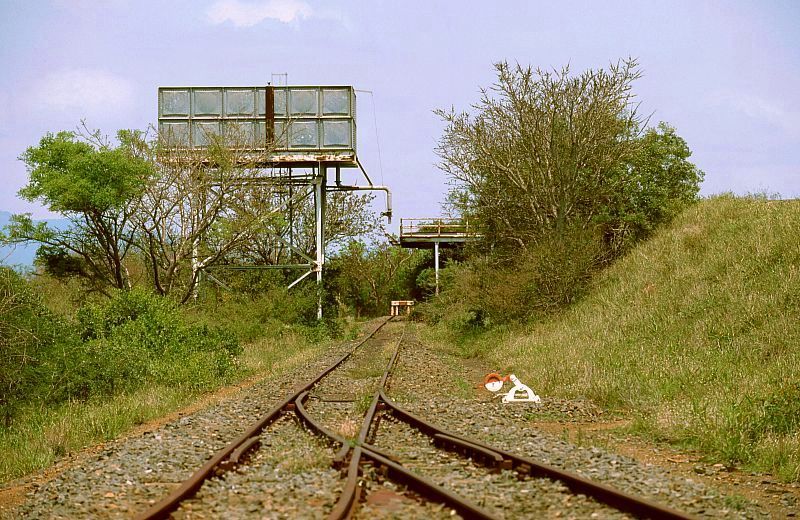
Driving southward leads us through Big Bend (which despite its timber industry is not touched by SR) to the border post of Lavumisa / Golela. Lavumisa on the Swaziland side was very quiet with a couple of loops and the remainders of a steam loco catering area. No shed, but otherwise complete with a coal stage, water column, and triangle; all deserted but still in a good shape. If you ever need to turn a steam loco in Swaziland, this is the place:


Golela
on the South African side of the border featured the trackwork of a typical border station with the layout divided in two halfs and a fence in between. Spoornet 37025, 37028, and 37046 sat waiting in front of a bunch of loaded timber wagons.


It is a pity that visits to South(ern) Africa tend to come with a bit of a hurry. I would have liked to spend a couple of hours linesiding, but there were so many things to see in only so many weeks... I hope that next time we will be able to enjoy the luxury of a more concise itinary.

Literature:
Middleton, John: Railways of Southern Africa Locomotive Guide 1994. Beyer-Garrat Publications, 1994. [JM94]
Lonely Planet: South Africa, 2004.
Railway Atlas of South Africa


back to the index


Ralph Timmermann, 7. May 2007